Plus my favorite ways to bring the magic of trees into your kitchen
To see all the books on this list on Bookshop, head to this link.

I am a lifelong lover of forests. And like any love that expands across decades, there is a depth that accompanies that breadth.
Over time, my knowledge of the “how” of forests has expanded to accompany the magic of experiencing a forest: I now know, for example, that the soil of the forest floor is as important to making the forest well, a forest, as the trees are.
This reading list is a small snapshot of my love of forests: Beginning at the forest floor and moving up through the canopy, before reflecting on the future of forests and our role within it.
The forest floor
The soil of the forest floor is teeming with life.
In just 1 tsp of healthy soil, you’ll find more microbes than there are people on Earth. Some of these microbes are the same ones we use to ferment our food: A practice that may have contributed to the development of our frontal lobes and that has dramatically shaped how we eat over millennia.
Mycelial networks spread out across the floor of the forest, between the trees and plants: Most famously described by Suzanne Simard, who discusses this unfolding in her scientific work and elsewhere, including her memoir, Finding the Mother Tree, that follows her relationship to forests, and the key moments that led her further down the path towards her work that would change how we view and understand the soil beneath our feet.
Mycelial networks share information between trees as well as nutrients, showing a sense of collective strategizing, resource sharing, and real-time adaptability that we might not associate with beings who live their lives standing in one place.
And the magic of these networks highlights intelligence that we tend to reserve for our own species (or maybe, if we’re feeling generous, to mammals, but never to plants): Ones like continuous care for offspring as they grow. Our understanding of these networks continues to grow and to deepen into the public consciousness thanks to authors like Merlin Sheldrake and to research by Monica Gagliano and others.
Perhaps it’s the fact that the shape and function of these networks mirrors other more familiar networks in nature, including our own nervous systems, that we’ve become fascinated with them.
Of course, this unfurling and branching is part of the roots of our forest’s trees and plants, too: It’s a shape that speaks to sturdiness and connection, to depth and expansion, perhaps to understanding ourselves as part of something bigger than just us as individuals (for those who have worked with me in other capacities, this was part of the inspiration for how I chose the names for Root and Roots + Branches).
The Understory
Ferris Jabr’s 2020 interview with Simard underscores the fact that moving from soil to trees is not a clear delineation: Rather than discrete categories, it’s an interconnected map. Each area of the forest being a single node, rather than the nexus, of the landscape. So as we move to the understory, it’s wise to bear Simard’s comments in mind:
“An old-growth forest is neither an assemblage of stoic organisms tolerating one another’s presence nor a merciless battle royale: It’s a vast, ancient and intricate society. There is conflict in a forest, but there is also negotiation, reciprocity and perhaps even selflessness.
The trees, understory plants, fungi and microbes in a forest are so thoroughly connected, communicative and codependent that some scientists have described them as superorganisms. Recent research suggests that mycorrhizal networks also perfuse prairies, grasslands, chaparral and Arctic tundra — essentially everywhere there is life on land. Together, these symbiotic partners knit Earth’s soils into nearly contiguous living networks of unfathomable scale and complexity. “I was taught that you have a tree, and it’s out there to find its own way,” Simard told me. “It’s not how a forest works, though.””
When I talk with others about forests, I tend to find they focus on the trees or, increasingly, also talk about the health of the soil. But the understory plants and smaller understory trees? Often overlooked, and underappreciated.
The understory makes me think of the magic hidden in plain sight: An opportunity to pause and look more closely and to truly observe what we are seeing.
Where I live in Georgia, our forests are filled with a dizzying variety of understory plants as well as overstory: Making some forests almost a solid wall of green in certain seasons. The shaded world of the understory contains its own magic that simply can’t exist in the full sunlight: Perhaps just as the parts of ourselves we keep hidden in the shadows contain their own magic if we’re willing to access it.
We often think of shade plants as primarily being a bunch of leaves: But the shade contains more treasures for those willing to pause and look. The pawpaw is delicious magic: The flavor of place that also tastes, surprisingly, like the flavor of places with very different ecosystems.
Part of the magic of the understory is that its members participate in the forest community in a way that’s essential, but not towering: A reminder that our contributions to our own networks are essential whether or not we’re the biggest or most visible person in the room.
On my to-read list is the book Understories, about the stories beneath the main narrative of a story, and I’m curious to read it because in forest terms this feels so appropriate for the role of the understory as well as its name: The story underneath the larger, more visibly present part of the narrative (in this case, the overstory): the under story, then, may not be center stage, but without it, the larger story of the forest simply could not exist.
The Overstory
The overstory is where giants live. The trees that tower over us on our hikes and shelter our homes. The trees that feed us and our
The overstory makes me think of the ways our language shapes our understanding of the forest: The words we choose, unconsciously or not, may be part of our under story, but become so interwoven with the main event that, like our forest understory, the two are inextricable.
I love to be transported by Robert MacFarlane’s writing, and in Landmarks, he explores the language of place, both how the choices we make in how we describe place and what aspects of it we highlight or ignore, but also how place shapes our language.
Like the understory and overstory, the words we use and the places we are become interwoven and that bond is strengthened or diminished by how deeply our words remain rooted in the physical spaces where we experience them.
In Rooted, Lydia Lynn Haupt encourages us to consider the term kith rather than kin when describing the natural world, as kith offers the possibility of intimacy rather than just relatedness. Rather than relatives we see on holidays and otherwise ignore, each member of our wild world is respected and their agency in the world recognized.
But because of our intimate connection, they are being we turn towards out of love: Like the family member or friend you text first thing when anything noteworthy happens, or the friend whose company you relish and look forward to. Rather than nature being “over there,” allowing ourselves a deep, intimate connection reminds us that we are nature. That the interconnections of the forests are here, too.
The Overstory is an experience of language’s connection to place, and our connection to ecosystem, in a narrative structure I find absolutely compelling. Without giving too much away, I appreciate that the actual movement of the narrative in the book mimics the mycelial network of a forest: Showing bits of hyphae spreading between storylines, but the layout of the forest itself is unclear until the end.
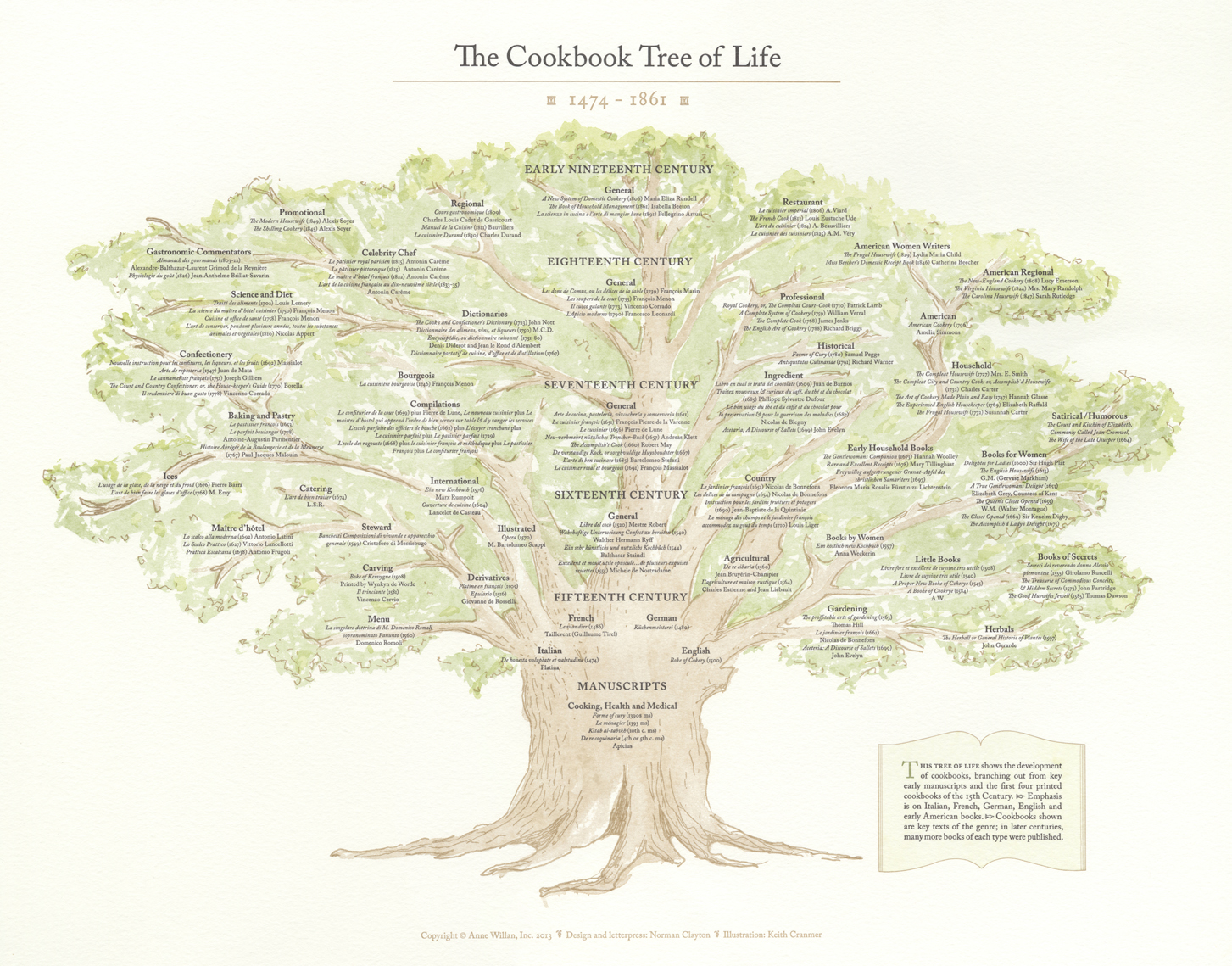
And speaking of connections, we humans also love trees and forests as metaphors for other non-tree things (though in this case, often made of trees): I enjoy climbing around on the various branches of Ann Willan’s Cookbook Tree of Life.
A forest can be many things and exist in many places: I always associated forests with mountains as a child, growing up in the Rockies, but now I know forests exist within many environments and intersect with many species and communities of species, including our own. Janisse Ray’s Ecology of a Cracker Childhood remains a beloved favorite, weaving memoir with the ecology of place, anchored to the story of species emblematic of place: in this case, the longleaf pine.
Like Simard, the memoir maps an unfolding relationship to place, and of how place shapes the trajectory of our lives. And how even the memories of a changed and changing place (such as those longleaf forests, now almost a rarity in the region) can shape us for our entire lives. That’s the power of a forest. And the power of our relationship to the beings within them.
The Forested Future
When we take a birds-eye view above our forest, we can ask what the future looks like for forests? What magic do we find by connecting with the forest? And what losses, as in the case of the American Chestnut, tower over us and demand our attention?
A thriving future is an interconnected one: And we are in a moment that asks us to radically reimagine what that looks like and means. In recent months, I’ve felt anxiety about the liminal yet tumultuous nature of this moment: Something far from unique to me. You’ve probably felt it in some shape or form, too.
Something shifted when I let myself feel the fear of old systems breaking down or changing, but also let that fear also step aside for excitement: Because I’m here, as you are, at a time where we get to participate in building what’s coming next.
You know how I talk about us being a living bridge between the traditions of the past and the not-yet-birthed world of the future? We’re living it, y’all, big time and in real time.
Part of shaping those systems is an opportunity to reimagine our relationship with what’s already here: Maybe building something new isn’t starting from the ground up. Most of it is returning to appreciation of, and connection with, what we’ve taken for granted.
There is a need to listen to, and learn from, Indigenous perspectives on land as partner rather than land as resource. And listen and learn also means acknowledging how we all fit within that system: Rather than “listening and learning” as an extractive, performative act. This includes rethinking our perspective of the wild (and each other) as “other” and wilderness as “over there” (as my friend Jeffery Darensbourg tells me, “wildnerness is a colonial concept.” You can read more about colonialism and wilderness here).
So what forested future are we building? Perhaps one where we journey with and listen to the plants themselves, as Maria Rodale does. Perhaps we’ll view our forests as social, vital spaces in their own right rather than simply our own recreational spaces or places to extract resources. Maybe, if we slow down and listen to the wisdom at all the levels of the forest, we’ll remember their magic, and that we’re a part of it.
Recipes: Cooking with the magic of trees
You probably already work closely with trees in your kitchen, perhaps without being aware of it: from aromatic nutmeg nuts and mace (the spicy, fragrant webbing that surrounds the nutmeg itself), to warming cinnamon (which is a bark), to pecans or any of the other cultivated nuts we love to eat (though pecans may be my favorite).
But there are some ways to expand this practice to work with trees that are closer to home. Here are my favorites:

Subscribe to continue reading
Become a paid subscriber to get access to the rest of this post and other exclusive content.